

Super savings are for retirement. However, as a result of the financial hardship caused by coronavirus, access to super may have been an important way to help you make ends meet at a difficult time. We consider how you can boost and rebuild your retirement savings when your circumstances allow.
Early access to super – important considerations
The impact of a withdrawal on your future retirement savings will differ based on a number of important variables, including:
- how much you withdraw
- your age and years until retirement
- your investment allocation and future returns
- fees and other account expenses, and
- contributions made to your account.
Boosting and rebuilding your savings
While your top priority was maintaining the cashflow you need to meet ongoing family and lifestyle expenses, there are some great ways that you may be able to boost your retirement savings when you have the surplus cash available to do so.
It may give you some peace of mind to know that you are able to make what might be a necessary decision today to access some of your super savings to assist you and your family at a difficult time, without compromising your retirement. In the future, even small, regular contributions could be important in getting your superannuation savings back on track for retirement as every little bit helps.
We have summarised how some of the below strategies could help you to boost your retirement savings between now and retirement. When your circumstances change and you have opportunity to consider rebuilding your retirement savings.
Rebuilding superannuation
Strategies at a glance
Below is a summary of some of the key contribution strategies available to boost and rebuild your retirement savings.
Salary Sacrifice
At a High Level…
Who could this work for?
This may be appropriate for those who have sufficient cashflow to divert some of their pre-tax salary to super rather than as take home pay. It does not need to be a large amount to start and you can further increase the amount that you contribute
in the future once things are really back on track.
Strategy at a glance
If, and when, the time is right, you may be able to arrange for your employer to contribute some of your future pre‑tax salary, wages or bonus directly into your super fund.
Some important information
Salary sacrifice contributions count towards the ‘concessional contributions’ (CC) cap. CCs also include employer contributions and personal contributions claimed as a tax deduction. Breaching the cap may lead to additional tax penalties.
What is the benefit?
Savings boost
By making regular additional contributions to super, you are helping build up your account balance again. Do not be afraid to start small if it is all you can commit – even small incremental amounts add up over time. The sooner you can start making even small contributions, the better- the power of compounding returns will have the chance to work harder for you. Salary sacrifice contributions are made from your pre-tax salary which can be a great, disciplined way to save for retirement. However, if your income or expenses are not consistent or predictable, there are other ways.
Tax management
Salary sacrifice contributions are generally taxed at the concessional rate of up to 15% [1], rather than your marginal rate which could be up to 47% [2]. Depending on your circumstances, this strategy could therefore reduce the tax you pay on your salary and wages by up to 32%. By paying less tax, you can make a larger investment for your retirement. You could even consider diverting the tax savings to super to boost your savings further.
Government Co-Contribution
At a High Level…
Who could this work for?
People who earn [3] less than $53,564 pa [4], and can make personal (after-tax) super contributions of up to $1,000 pa – less than $20 per week.
Strategy at a glance
If you meet the requirements and make personal (after-tax) contributions of up to $1,000 pa, the Government will also contribute up to $500 into your super account. The amount you are entitled to will vary based on your income and the total annual personal contributions that you make. As a general rule, in 2019/20:
- the maximum co-contribution of $500 is available if you contribute $1,000 and earn $38,564 or less, and
- a reduced amount may be received if you contribute less than $1,000 and/or earn between $38,564 and $53,564.
Personal (after-tax) contributions count towards your non-concessional contribution cap.
What is the benefit?
Savings boost
By making regular additional contributions to super, you are helping build up your account balance again.
What is even better is by receiving additional help from the Government, your savings may be boosted even faster. If you are entitled to the maximum co-contribution, this means your super contributions will be increased by $1,500 pa from this strategy alone.
The earnings on your savings are taxed at 15% rather than your marginal rate which could be up to 47%.
Spouse Contribution and Receive a Tax-Offset
At a High Level…
Who could this work for?
Members of a couple, where one spouse earns less than $40,000 p.a. and there is capacity to make a super contribution on behalf of a spouse.
Strategy at a glance
If you make an after-tax contribution into your spouse’s super account and they earn less than $40,000 pa, you may be eligible for a tax offset of up to $540.
To qualify for the full offset of $540 in a financial year, you need to contribute $3,000 or more into your spouse’s super account and your spouse must earn [5] $37,000 p.a. or less.
A lower tax offset may be available if you contribute less than $3,000 or your spouse earns more than $37,000 pa but less than $40,000 pa.
A spouse contribution counts towards your spouse’s non-concessional contribution cap and must be within this cap to entitle you
to the tax offset.
What is the benefit?
Savings boost
Spouse contributions can be a great way to grow your super as a couple and to be ‘rewarded’ via a tax offset for saving for retirement.
Tax management
Not only could you boost your spouse’s super, the tax offset could help reduce your income tax. You could use these tax savings to provide an even larger super savings boost, helping to fund additional contribution in the next financial year.
Personal Contributions and Claim a Tax Deduction
At a High Level…
Who could this work for?
This might be right for you if you are able to make personal after-tax contributions to super. Unlike salary sacrifice contributions, personal deductible contributions can be made with your take home pay or savings.
You can do this regularly, or you could even wait until closer to the end of financial year, which could provide greater flexibility and planning options if you have irregular income or expenses and need to review your circumstances before committing to a regular contribution.
Strategy at a glance
You could make a personal super contribution and claim a tax deduction for the amount, which will also reduce your assessable income. These contributions are treated as CCs and count towards your CC cap. Exceeding your cap may result in significant tax penalties.
What is the benefit?
Savings boost
By making additional voluntary contributions to super, you are helping to rebuild your account balance. What is more, making tax effective super contributions can be a great way to boost your cashflow even more.
Tax management
Making a personal deductible contribution could help to reduce your assessable income and manage your tax liability. The contribution will generally be taxed in the fund at the concessional rate of up to 15% [6],instead of your marginal tax rate which could be up to 47% [7].
Depending on your circumstances, this strategy could result in a tax saving of up to 32% and enable you to increase your super. You could put some or all of these savings towards making even more super contributions in the following year.
It could also help you to manage capital gains tax and if you have unused CCs (see below ‘Catch-up concessional contributions) you could make larger contributions and claim an even larger tax deduction.
Depending on your circumstances, this may even result in you receiving a tax refund at the end of the year. You could use this tax refund to further boost your retirement savings by making another super contribution in the following year.
Catch-Up Concessional Contributions
At a High Level…
Who could this work for?
If you have not fully utilised your annual concessional contributions (CC) cap since 1 July 2018, you may have accrued ‘unused’ CCs that could enable you to make larger contributions in a future year. Unused CCs can be carried forward for up to 5 years.
What does it involve?
If you meet the eligibility criteria and have accrued unused concessional contributions, you may be able to top up any employer contributions by making:
- personal contributions that you claim a tax deduction for, or
- salary sacrifice contributions.
You could do this for example:
- when you receive a bonus
- once you have sufficient cash flow to divert regular pre-tax salary to super
- when you receive a refund from your tax return, or
- with proceeds of sale from an investment or other asset, or windfall.
These contributions are treated as CCs and count towards your CC cap. Exceeding your cap may result in significant tax penalties.
What is the benefit?
Savings boost
By making regular additional contributions to super, you are helping build up your account balance again. What is more, making tax-effective super contributions via salary sacrifice or a personal deductible contribution (see below) can be a great way to boost your cashflow even more.
Tax management
CCs are a tax effective way to save for retirement. This means more of your money (after-tax) is invested for you today. If you’re able to make even larger CCs by using the catch-up contribution rules, not only is this an even greater boost for your retirement investments, but the tax savings (which you might receive via a refund on your tax return) could be even greater.
This could either help with cashflow or provide you with even more capacity to make additional contributions to super in a future financial year.
Salary sacrifice contributions are generally taxed at the concessional rate of up to 15% [8], rather than your marginal rate which could be up to 47% [9]. The tax deduction you claim for personal contributions reduces your assessable income and generally provides a tax saving.
Also, earnings on your super savings are taxed at 15% compared to your marginal tax rate of up to 47%.
Case study – benefits of rebuilding
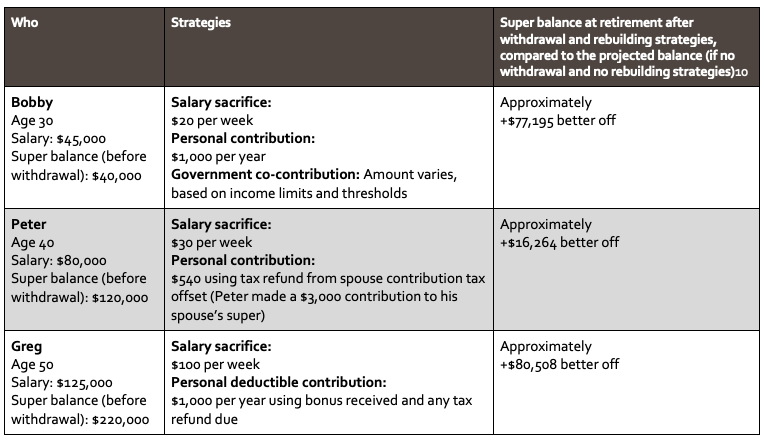
Greg (50), Peter (40) and Bobby (30) have all recently been impacted by the coronavirus pandemic, having been made redundant or stood down from employment. Each is concerned about the impact that a withdrawal under the temporary coronavirus condition of release will have on their future retirement savings.
Potential impact on future retirement savings
Given each person’s circumstances, their financial adviser suggests to make the withdrawals. However, when the time is right in the future, there are a number of strategies that could be implemented to help get their retirement savings back on track.
Their adviser completes some projections to show the incremental benefit of even small contributions and strategies between now and retirement. The news is good, even after withdrawing the maximum amount of $20,000. With the right advice, each of them should be able to rebuild their super savings. The projections also show that they should be able to save even more for retirement and may retire with an even larger balance.
Next steps
To find out more about how these strategies could work for you or any other issues or concerns you may have, contact our office on 02 6884 4680 or [email protected] to arrange your free consultation meeting.
[2] Includes Medicare Levy.
[3] Includes assessable income, reportable fringe benefits and reportable employer super contributions less business deductions. At least 10% of income must be from eligible employment or carrying on a business. Other conditions apply.
[4] Threshold applies in 2019/20. From 1 July 2020 this increases to $54,837.
[5] Includes assessable income, reportable fringe benefits and reportable employer super contributions.
[6] Individuals with income above $250,000 in 2019/20 will pay an additional 15% tax on personal deductible and other concessional super contributions.
[7] Includes Medicare Levy.
[8] Individuals with income above $250,000 will pay an additional 15% tax on salary sacrifice and other concessional super contributions within the cap.
[9] Includes Medicare Levy.
[10] Modelling estimates are based on a range of assumptions and individual outcomes may vary. Outcomes are displayed in today’s dollars, Annual salary increases are in line with assumed rates of CPI, with employer contributions at the legislated minimums. Recommended contributions are unindexed. Government co-contributions are calculated annually based on entitlement resulting from salary and projected income thresholds. Investment returns are based on a return rate of 7.77%, and ignores fees for simplicity. Based on current tax and superannuation rules which are assumed to remain unchanged. Retirement age is 65 in all case studies.
Glossary
Assessable income- Income, including capital gains, you receive before deductions.
Capital gains tax (CGT) – A tax on the growth in the value of assets or investments, payable when the gain is realised. If the assets have been held by an individual, trust or super fund for more than 12 months, the capital gain generally receives concessional treatment.
Concessional contribution cap – A cap that applies to certain super contributions. These include, but are not limited to:
- personal contributions claimed as a tax deduction, and/or
- contributions from an employer (including salary sacrifice).
Concessional contributions are taxed at the concessional rate of up to 15%. If you are a high income earner (with income for
this purpose above $250,000) you will pay an additional 15% on certain concessional contributions you receive.
The current concessional cap is $25,000. If you are eligible, you may be able to carry forward unused concessional contributions to make larger contributions in a future year. You may be able to carry forward unused concessional contributions for up to five years. Eligibility rules apply. If you exceed the concessional cap, additional tax penalties may apply.
Condition of release – Circumstance upon which you can withdraw your super benefits. This is generally when you reach age 65 or meet the specific ‘retirement definition’. In certain circumstances you may be able to access some of your super early if you meet certain other conditions, generally related to hardship. See ato.gov.au for more information.
Marginal tax rate – The stepped rate of tax you pay on your taxable income.
Non-concessional contribution cap – A cap that applies to certain ‘after-tax’ super contributions. These include, but are not limited to:
- personal after tax contributions, and
- spouse contributions received.
The cap is currently $100,000. However, if you are under age 65 at some point during the financial year, it may be possible
to contribute up to $300,000 in 2019/20, provided your total non-concessional contributions in that financial year, the last two proceeding years, and the following two financial years, do not exceed $300,000. If the cap is exceeded, excess contributions may be taxed at the top marginal tax rate of 47% if not removed from the fund.
Personal after-tax super contribution – A super contribution made by you from your after-tax pay or savings.
Salary sacrifice – An arrangement made with an employer where you forgo part of your pre-tax salary in exchange for receiving certain benefits (e.g. super contributions).
Spouse contribution – An after-tax super contribution made on behalf of an eligible spouse. If the receiving spouse has income (for this purpose) of less than $40,000, the contributing spouse may be eligible to claim a tax offset of up to $540.
Superannuation Guarantee (SG) contributions – The minimum super contributions an employer is required to make on behalf of eligible employees is 9.5% of ordinary times earnings in (2019/20) up to the maximum super contribution base limit of $55,270 (2019/20) per quarter.
Tax deduction – An amount that is deducted from your assessable income before tax is calculated.
Tax offset – An amount deducted from the actual tax you have to pay (e.g. franking credits).
Taxable income – Income, including capital gains, you receive after allowing for tax deductions.
Important information
This document and its contents are general in nature and do not constitute or convey personal advice. It has been prepared without consideration of anyone’s financial situation, needs, or financial objectives. Formal advice should be sought before acting on the areas discussed. This document is a private communication and is not intended for public circulation other than to authorised representatives of the Madison Financial Group and their clients. The authors and distributors of this document accept no liability for any loss or damage suffered by any person as a result of that person, or any other person, placing any reliance on the contents of this document.
This document has been prepared by GWM Adviser Services Limited (ABN 96 002 071 749, AFSL 230692) (GWMAS), part of the National Australia Bank group of companies. Information in this document is current as at 5 May 2020. While care has been taken in its preparation, no liability is accepted by GWMAS or its related entities, agents or employees for any loss arising from reliance on this document. Any opinions expressed constitute our views as at 5 May 2020. Case studies are for illustration purposes only. Any tax information provided is a guide only. It is not a substitute for specialised tax advice.
GWM Adviser Services Limited (ABN 96 002 071 749, AFSL 230692) (‘GWMAS’). A member of the National Australia Bank Limited (‘NAB’) group of companies. NAB does not guarantee or otherwise accept any liability in respect of GWMAS or these services.
The post How To Rebuild Your Superannuation After Early Access appeared first on Ironbark Wealth Advisers.